Rococo Revival
I’ve been daydreaming about boudoirs and powdered wigs, and I want to take you into a shimmering world where pastel swirls, gilded scrolls, and delicate flourishes reign supreme. This is Rococo Revival—the modern reawakening of an eighteenth-century aesthetic riding a wave back into fashion, interiors, and the imagination.
What Is Rococo Revival?
“Revival” is always slippery—it means reinterpreting, not copying. Original Rococo was born as a counterpoint to the grand drama of Baroque: where Baroque is bold and symmetrical, Rococo is intimate, whimsical, and often asymmetrical. Think shells, vines, flowers, and airy curves.
Nineteenth-century designers brought those forms back with fresh energy, layering drama and intricacy, sometimes deepening the palette but keeping the devotion to carving and scrollwork. Today’s revival is gentler again—romantic pastels, gilded details, and a postmodern permission to mix eras without apology.
Why Now?
- Nostalgia and escape. In a world that can feel austere and hyper-digital, the lush detail of Rococo offers sensory luxury and romantic fantasy.
- Maximalist momentum. After years of beige minimalism, people want personality: layers, ornament, mood.
- Cross-generational charm. From Gen Z mood boards to heirloom lovers, the aesthetic bridges tastes and timelines.
- Fashion echo. Corsetry, ruffles, sculptural ruching—all those playful silhouettes are back on runways and sidewalks.
How to Spot It
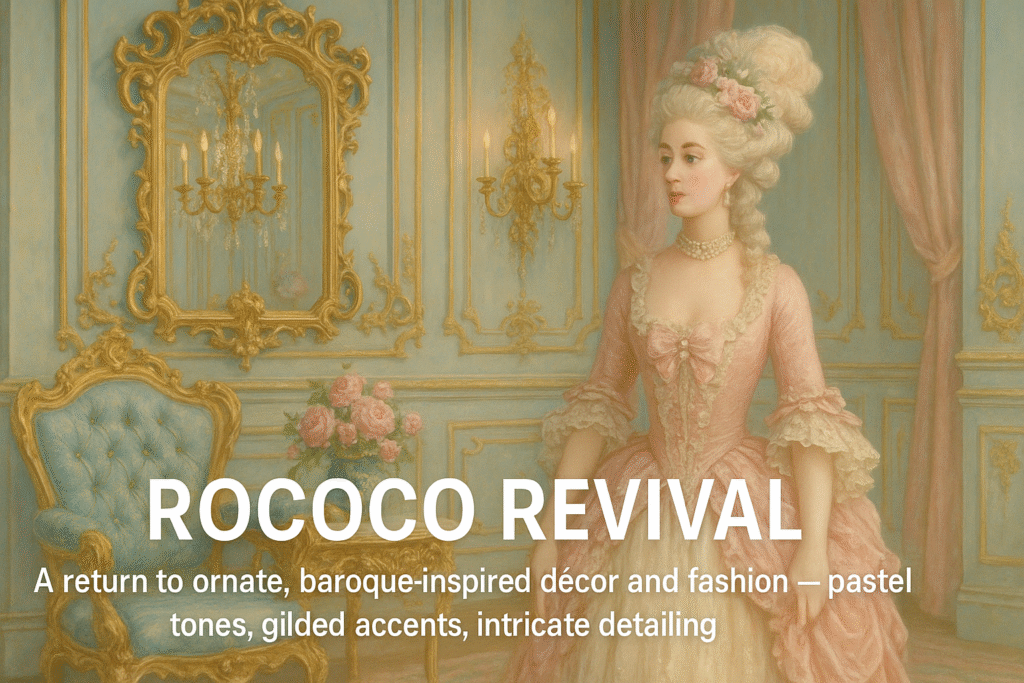
- Curves & scrolls: Asymmetrical C- and S-shapes in frames, moldings, and furniture legs.
- Intricate carving: Shells, acanthus leaves, garlands, floral sprays in wood or plaster.
- Pastel palette: Powder blue, blush, mint, ivory—lifted with touches of gold.
- Gilded accents: Mirrors, hardware, and lighting that add a warm, lustrous glow.
- Luxe textiles: Silk, satin, brocade, velvet—often tufted, ruched, or embroidered.
- Light play: Oversized mirrors and crystal chandeliers to scatter and multiply light.
- Mix of eras: A carved console under a modern art print; a gilt mirror above a clean-lined sofa.
Rococo at Home
Salon / living room. Anchor the space with a carved gilt mirror or console. Add a pale-blue settee, a marble-top table with scrolling legs, and a chandelier dripping with crystal. Let layered rugs and floral tapestries soften the edges.
Bedroom. A canopy (or a sumptuous tufted headboard), ruffled duvets, and a vanity with a shell-framed mirror. Whisper, don’t shout.
Dining. Round or oval table, damask-upholstered chairs, candlelight, floral china, a silk runner that catches the gleam of gold.
Nooks & accessories. Wall niches with porcelain figurines, ornate sconces, silk drapery pooling just so. One decadent gesture beats a dozen small ones.
Rococo in Fashion
- Corsets, ruffles, lace, and draped sleeves— echoes of court style reimagined for now.
- Pearl and enamel jewelry with scrollwork and delicate motifs.
- Printed silks and satins: florals, vines, filigree.
- Styling flourishes—gloves, ribbons, parasols—small nods without going full costume.
Modernizing the Ornate
- Start with a statement. One mirror, one chandelier, or one carved piece sets the tone without overwhelming.
- Hide the tech. Route cords behind panels, tuck chargers into decorative boxes, keep screens clean-lined.
- Mind the scale. Large ornate pieces can dominate small rooms—balance with negative space and light woods.
- Blend boldly. Pair a Rococo chair with minimalist walls or a modern lamp. Friction creates freshness.
- Choose soul. Vintage, artisan-made, and real materials age beautifully and carry the hand of the maker.
There’s something deeply human about ornamentation. We crave touch, stories, and detail. In a time when so much is flat and fleeting, revisiting the sumptuous and tactile feels like a gentle rebellion.
A Return to Ornate
Rococo Revival invites us to slow down—to trace a scroll with a fingertip, to linger by candlelight, to fall into pastel dreams. It isn’t about imitating the past; it’s about letting the past remind us that elaborate can still feel fresh. If you feel even a flutter—be it a mirror, a cushion, or a ribbon—follow it. One flourish at a time.